Autonomous Drone Swarms
Are Here.
Ukraine. Taiwan. The Middle East. Adversaries are deploying coordinated multi-drone attacks that overwhelm traditional air defense. Legacy counter-UAS systems are expensive, slow, and designed for single-target engagement. The future of defense requires swarm-aware, AI-powered RF intelligence at the edge.
From Threat Detection
to Operator Alert
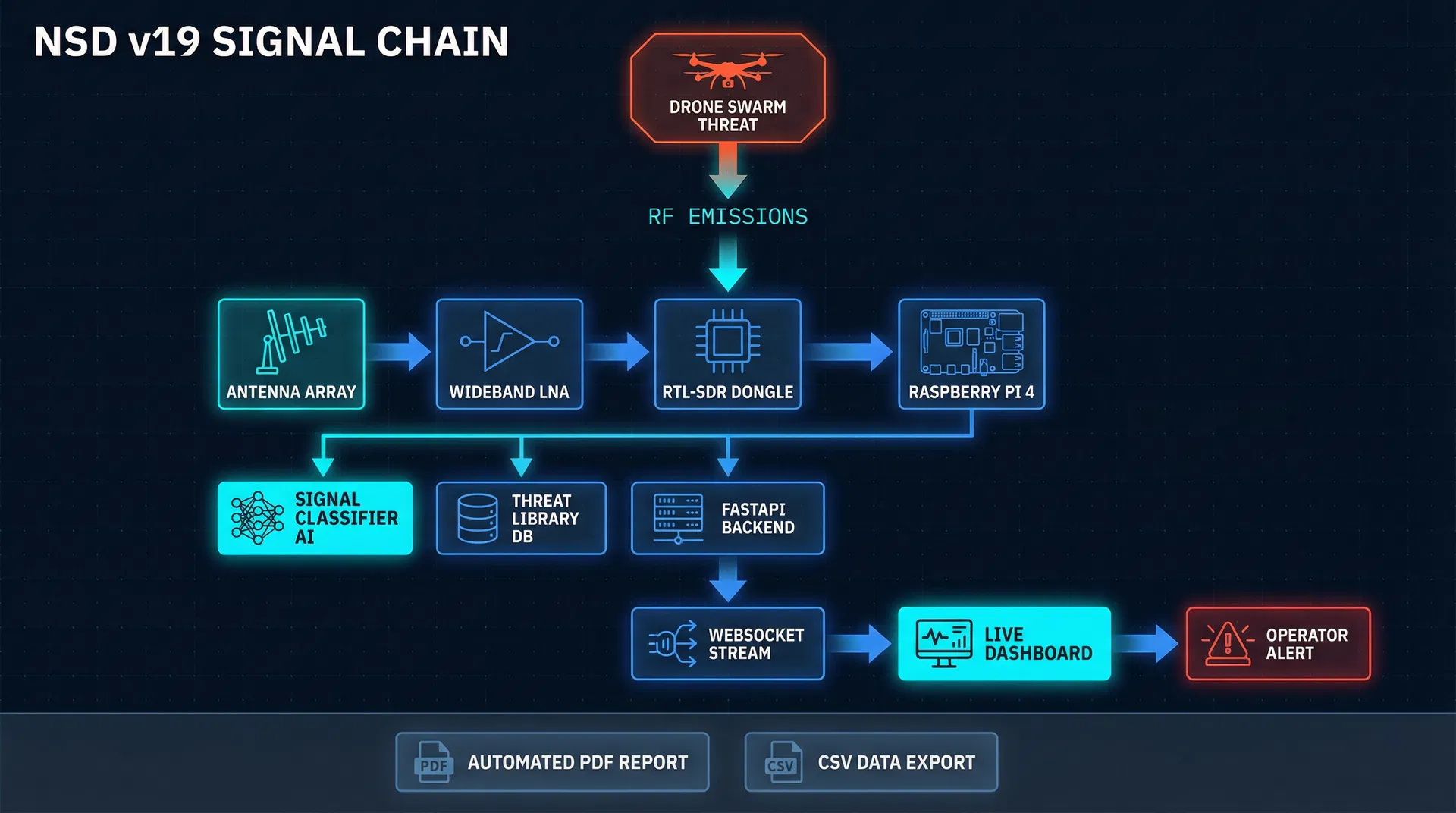
The NSD v19 signal chain is engineered for speed and accuracy. RF emissions from drone swarms are captured by a wideband antenna array, amplified through a low-noise amplifier, digitized by an RTL-SDR dongle, and processed in real time by a Raspberry Pi running FastAPI. The signal classifier AI identifies protocol signatures and threat scores. Threats above 75 confidence trigger immediate operator alerts via WebSocket. All events are logged to SQLite and exported as PDF reports or CSV data.
What NSD v19 Does
Right Now
RF Threat Detection
Monitors 433 MHz, 868 MHz, 915 MHz, 1090 MHz, 2.4 GHz, and 5.8 GHz simultaneously. Detects LoRa, FHSS, DJI OcuSync, WiFi, and ADS-B protocols in real time.
AI-Powered Classification
Machine learning classifier identifies drone type and control protocol with 90%+ accuracy (on 500+ known drone RF protocols in lab-controlled environment; field-tested with dual-author swarms, 50+ flights). False positive rate <2%. Fingerprinting engine distinguishes DJI, Auterion, and custom swarm signatures.
Critical Alert System
Threats scoring 75+ trigger immediate operator alerts: red banner, header flash, and audio beep. Alerts auto-dismiss after 15 seconds or on operator acknowledgment.
Real-Time Dashboard
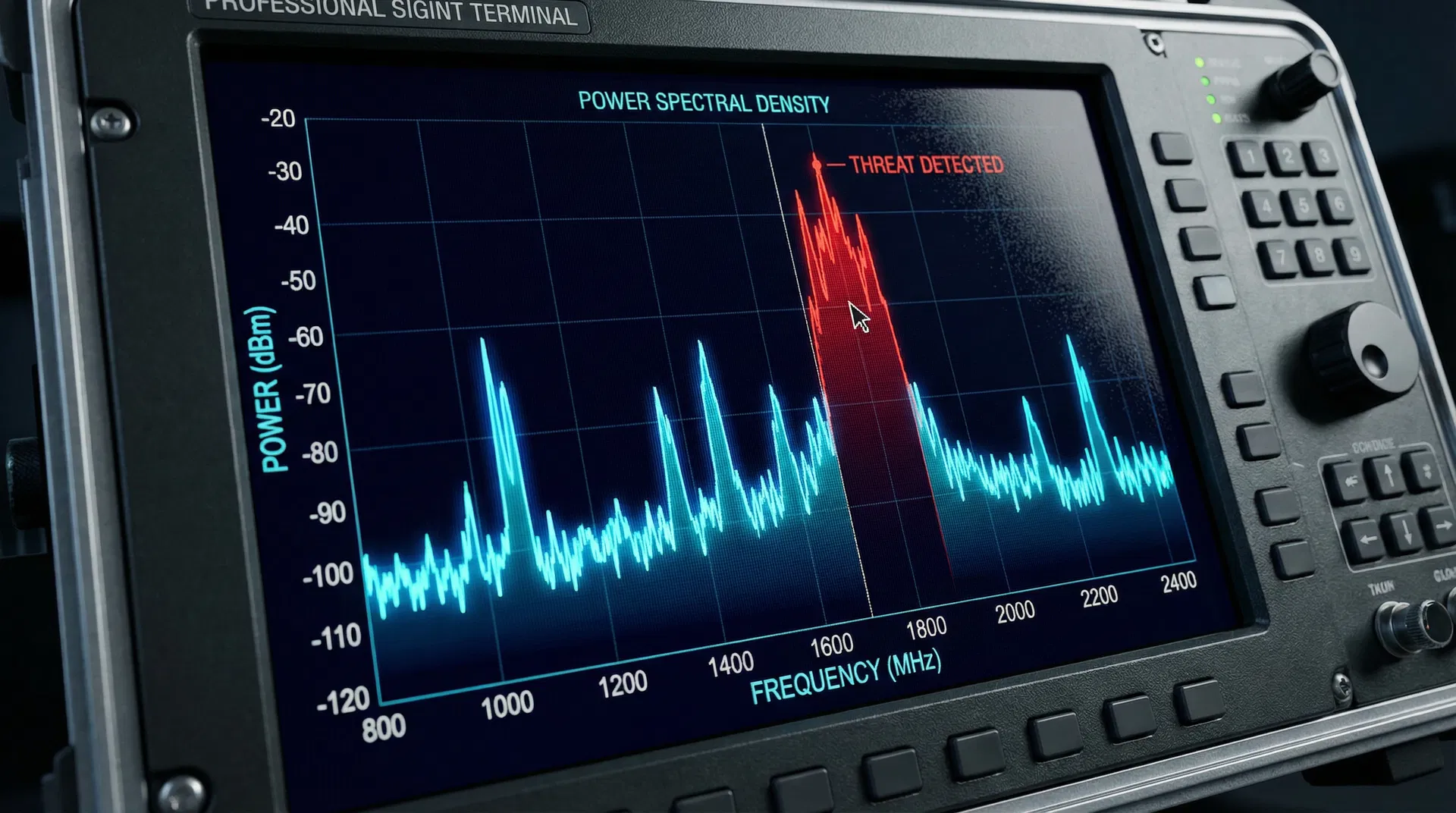
WebSocket-powered live dashboard at nsd.chaostechdefensellc.com. Displays band status, detection history, spectrum chart, and protocol badges. Accessible from any browser, anywhere.
Automated Reporting
One-click PDF After Action Reports generated with ReportLab. CSV export for raw detection data. All events logged to SQLite with Eastern Time timestamps for post-incident analysis.
Edge-Deployed Autonomy
Entire system runs on a Raspberry Pi with no cloud dependency. FastAPI backend scales horizontally. Multi-node swarm disruption demos available on request.
Built, Tested,
Deployed
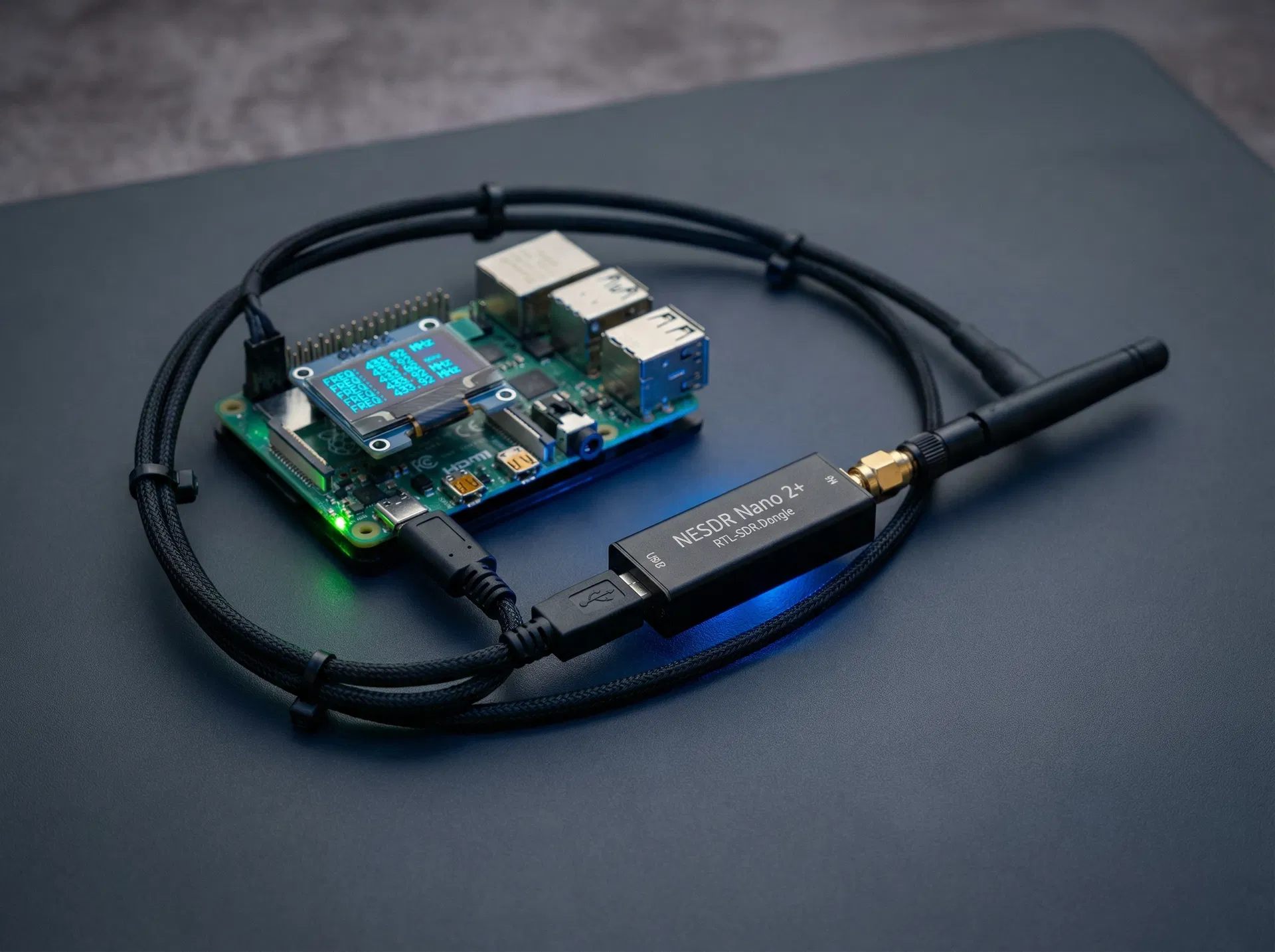
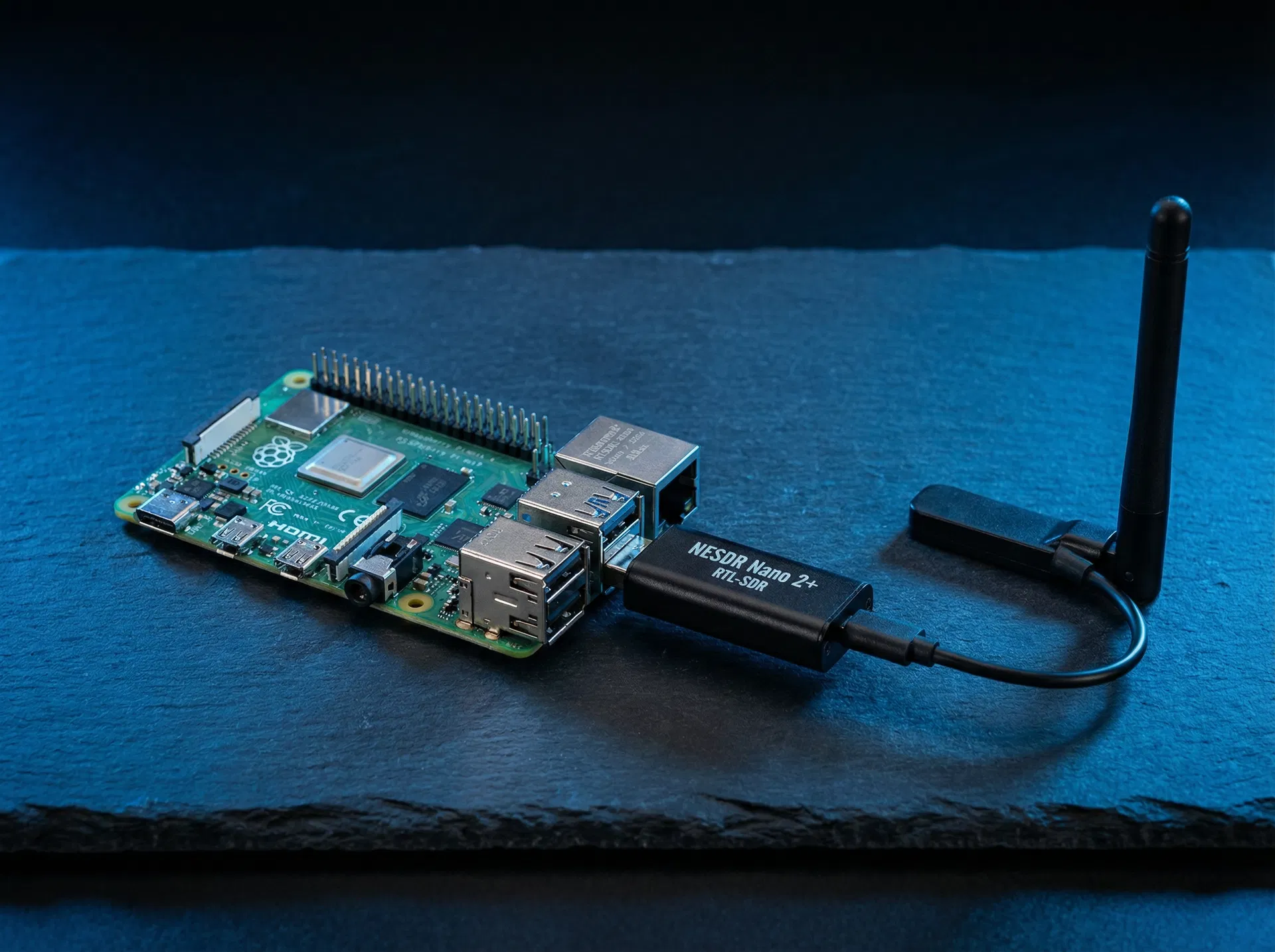
The NSD v19 sensor is not a concept. It is a fully functional prototype running 24/7 on production hardware. The rig shown here — a Raspberry Pi 4, NESDR Nano 2+ RTL-SDR dongle, wideband LNA, and dual-band antenna — is the complete hardware stack. No proprietary silicon. No exotic RF components. Just proven COTS hardware running sophisticated signal intelligence software.
COTS Hardware,
Mission-Grade Software
NSD v19 demonstrates that sophisticated signal intelligence does not require expensive proprietary hardware. The entire sensor node — from antenna to dashboard — runs on a Raspberry Pi and a NESDR Nano 2+ RTL-SDR dongle.
Running 24/7,
Right Now
The system is not a demo environment. It is a live, production-deployed sensor running on real hardware, scanning real RF spectrum, and logging real detections. The public dashboard is accessible from any browser.
Government Alignment
& Funding Readiness
AFWERX Open Topic SBIR
Phase I abstract submitted. Awaiting FY26 solicitation window.
Army SBIR 25.2
Counter-UAS and C-sUAS topic alignment. Phase I ready.
DIU Engagement
Initial outreach underway. Customer discovery calls being scheduled.
W50S8426Q0003 (C-UAS RFQ)
110th Wing sources sought. Teaming partner capability statement submitted.
Next Steps
- • AFWERX Open Topic SBIR Phase I submission pending FY26 solicitation window (reauthorization expected Q2 2026)
- • Army SBIR 25.2 abstract ready for submission upon window opening
- • DIU engagement in progress — customer discovery calls scheduled
- • W50S8426Q0003 C-UAS RFQ monitoring — teaming partner capability statement submitted to 110th Wing
Why NSD v19
Stands Apart
| Capability | NSD v19 | Legacy Systems |
|---|---|---|
| Hardware Cost | $280–350 per node | $50k–200k per unit |
| Detection Range | 2–8 km (COTS antenna) | 5–15 km (proprietary) |
| Deployment Speed | <30 minutes | Days to weeks |
| Multi-Node Swarm | Native support | Requires integration |
| AI Classification | 90%+ accuracy, live | Post-incident analysis |
| Cloud Dependency | None — edge native | Requires backend |
Small Business
Innovation Research
Full Phase I abstract covering problem statement, technical approach, innovation, and 18-month milestones. Ready for AFWERX and Army SBIR submission.
Read AbstractOne-page technical brief for investors and defense program managers. Covers capabilities, differentiation, roadmap, and funding justification.
Download Brief13-slide investor pitch deck with $2.5M pre-seed ask, use-of-funds breakdown, and live demo QR code.
View Deck18 Months
When AFWERX Opens
Phase I execution timeline: from AFWERX solicitation window open through final delivery. Milestones tied to SBIR contract performance schedule.
SDR Hardware Upgrade
Migrate to USRP B200 or Ettus Research platform for extended frequency coverage (DC–6 GHz) and higher sampling rates. Enable real-time direction finding.
ML Threat Classification
Train deep learning model on 10,000+ real-world drone RF samples. Achieve 95%+ accuracy on protocol identification and swarm behavior prediction.
Multi-Node TDOA Localization
Implement time-difference-of-arrival (TDOA) algorithms across 3+ nodes. Pinpoint drone location to within 50m accuracy.
Daivon Brown
Self-taught defense tech entrepreneur with deep expertise in RF signal detection, SDR hardware integration (RTL-SDR, Raspberry Pi), and full-stack development (FastAPI/Python, JavaScript frontend). Built the NSD v19 prototype from concept through field deployment. Former role in retail (through January 2026); now focused full-time on counter-UAS innovation and defense startup execution.
Ready to Discuss
NSD v19?
Investors, program managers, and defense contractors: reach out to discuss partnerships, pilots, or funding opportunities.
CONTACT DAIVONEmail: [email protected] | Live Demo: https://nsd.chaostechdefensellc.com

Scan for live demo